VendorLens  ·  Vendor Governance & Risk Intelligence  ·  2024

An AI layer on top of vendor oversight — the work a Control Manager does before the risk committee meets

A working dashboard that scores vendor risk across six dimensions, tracks governance cadence, and generates committee-ready briefs using the Claude API — built to bridge a functional gap between PMO delivery management and vendor risk oversight.

the tool

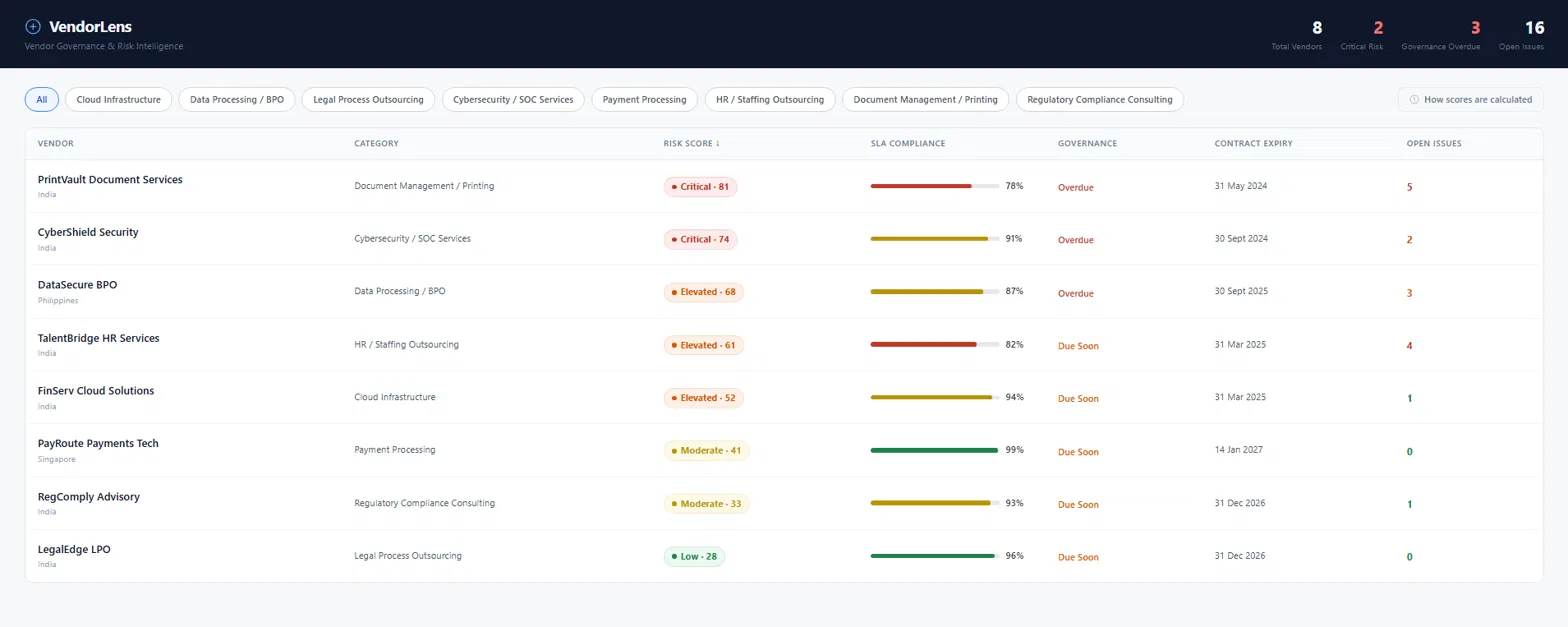
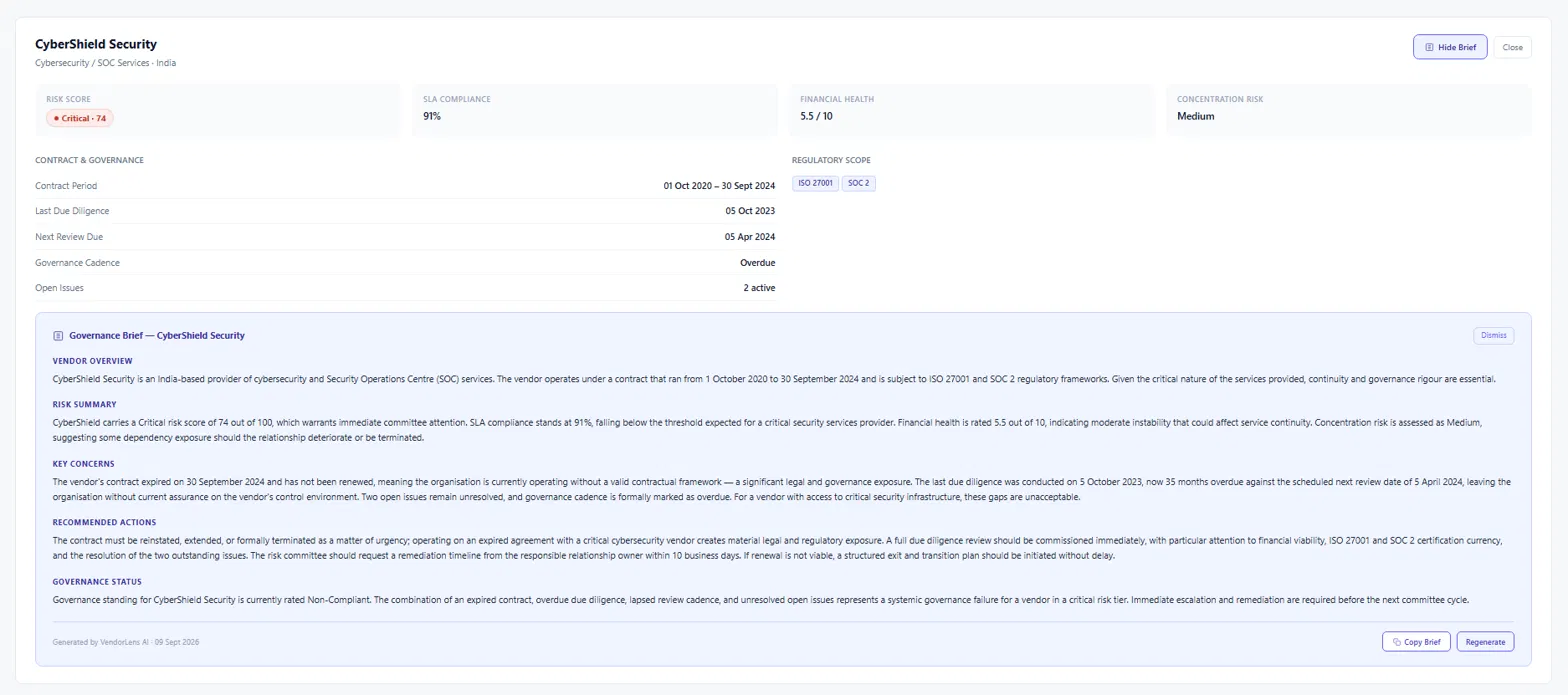
Two views — the vendor register sorted by risk exposure, and the AI-generated governance brief ready for committee review.

VendorPulse dashboard — vendor register sorted by risk score
Vendor register — 8 vendors scored across six risk dimensions, sortable and filterable by category
VendorPulse governance brief — AI-generated committee brief for CyberShield Security
AI governance brief — five structured sections generated from live vendor data, copy-ready for committee packs
8
vendors tracked
6
risk dimensions scored
3
governance overdue
5
sections per AI brief
the gap

Vendor oversight is a judgment-intensive discipline, not just a reporting exercise

Control Manager and Vendor Risk roles in financial institutions require translating raw vendor data — SLA rates, due diligence ages, contract proximity, financial health — into prioritised governance positions. That translation is where PMO skills fall short of what the role demands.

Most vendor dashboards surface data. Few help a manager answer the question a risk committee actually asks: which vendors need attention right now, and why?

the approach

A scoring model plus AI narration, structured around what a committee actually reads

VendorLens applies a six-factor weighted risk model to each vendor in the register, producing a score that reflects governance exposure rather than just operational performance. The AI layer then reads those scores and produces a structured brief — Vendor Overview, Risk Summary, Key Concerns, Recommended Actions, Governance Status — in the language a Control Manager would use.

The output is designed to be copied directly into a committee pack, not into a developer's inbox.

Why a multi-dimensional score, not just SLA compliance

The common proxy for vendor health is SLA compliance. It is the easiest metric to pull and the one most dashboards default to. But a vendor can be 95% SLA-compliant while operating on an expired contract, with a due diligence that is two years stale, and a financial health score that signals instability. Each of those facts individually is a governance concern. Together, they represent an unacceptable risk position — and averaging them into one number would obscure that.

The model below treats each dimension as a separate signal, weighted by how directly it contributes to regulatory or operational exposure. Concentration risk and governance cadence carry more weight than open issue count because their consequences are harder to recover from quickly.

Scores range 0–100. A vendor can score 81 with a 78% SLA rate — lower than a vendor scoring 52 with 94% SLA. That is intentional: the 81 also has an expired contract, a due diligence gap of over two years, and five open issues. The score reflects the full governance picture.

Factor Weight Rationale
SLA Compliance 25% Operational reliability is the most visible indicator of service quality. Vendors below 85% are treated as materially non-compliant.
Financial Health 20% Low financial health signals vendor instability and potential service disruption. Critical for any vendor providing essential or sensitive services.
Concentration Risk 20% High dependency on a single vendor amplifies the impact of any failure. Assessed as High / Medium / Low based on service criticality and substitutability.
Governance Cadence 20% Missed review cycles are a direct control failure. An overdue cadence is treated as a binary trigger — it adds a fixed penalty regardless of other scores.
Contract Proximity 10% Contracts expiring within 90 days require active management. Expired contracts contribute maximum score — operating without a contract is itself a governance breach.
Open Issues 5% Each unresolved issue adds to exposure. Four or more open issues are treated as a high-risk indicator regardless of their individual severity.

Architecture

Built as a single React component with no backend — all state lives in the client, vendor data is hardcoded JSON, and the only external call is to the Claude API when a brief is requested. This keeps the demo self-contained and deployable as a static file.

Skills mapped to the Control Manager role

The tool is an argument, not just a demo. Each design decision maps to a capability a vendor risk or control manager is expected to have.

Vendor risk assessment
The scoring model reflects how vendor risk is actually assessed — across financial health, operational performance, contractual coverage, and governance compliance — not just service delivery metrics.
Governance reporting
The AI brief output mirrors the structure of a real vendor governance note: overview, risk position, concerns, actions, status. The "Copy Brief" flow treats committee packs as the actual use case, not a screen export.
Due diligence oversight
Due diligence age is surfaced as a computed field (months since last DD) and treated as a first-class risk signal — not buried in a date field. Overdue reviews are flagged at the register level, not just in the detail view.
Regulatory framework literacy
Vendor records carry regulatory scope flags (ISO 27001, SOC 2, GDPR, PCI-DSS, Outsourcing Risk Framework). The AI brief references these flags in its risk and action sections, demonstrating that regulatory context drives governance, not the other way around.
Stakeholder communication
The brief prompt instructs the model to write for a senior audience in plain English. The output avoids jargon and data-dumps — the same discipline required when presenting to a risk committee or a CRO.
AI tooling for governance workflows
The tool demonstrates a practical AI integration pattern: structured data in, structured narrative out, with human review before distribution. This is how AI will be used in risk and compliance functions — augmenting judgment, not replacing it.